
This is the page the whole record was moving toward. The companion Courtroom File followed the case docket-by-docket through the closing weeks — the May 2026 omnibus order that took apart Wilson’s original theory, the July collapse of her witness list, the federal judge’s admonishment over her posting. On August 3, 2026, the case went to trial. On August 13, it ended. What follows is drawn from the public court record, save one closing note, clearly marked, from Wilson’s own public posts.
United States District Court · District of Hawaiʻi · August 13, 2026
The jury found for the defendants. Judgment shall be entered in favor of
P.H., B.H., and S.H..
Verdict returned and read in open court, 2:53 p.m. — polled and confirmed unanimous — jurors discharged. (ECF 244.)
The day the verdict came in
The jury reached its verdict on the second day of deliberations. The court’s minutes for August 13 are headed “Further Jury Deliberation Day 2”: the eight jurors resumed at 8:30 a.m. and, through the morning, sent the court two written notes — each taken up with counsel in a brief status conference before a response went back to the jury room.
At 1:30 p.m. the court was notified that a verdict had been reached; at 2:53 p.m. it was returned and read in open court. It went for the defendants. The minute order records that judgment shall be entered in favor of the three named defendants, that the jury was polled and its verdict confirmed unanimous, and that the jurors were then discharged.
The plain fact is the one worth sitting with: this was Liane Wilson’s lawsuit — the wellness influencer who posts as “Liana Shanti.” That was not the whole of how she presented herself. In 2022, the year she filed, her website said that although she did not adhere to a label, she had been referred to as “psychic, visionary, spiritual teacher, medicine woman, teacher, mentor, shaman, energy worker,” as well as artist, nutritionist, wellness educator, lawyer and mother, and it described her as “Psychic since childhood.”
The Daily Beast reported in April 2023 that she runs the Lemurian Mystery School and says she has supernatural powers, a direct line to Jesus Christ, and the ability to read the Akashic records. Its March 2023 investigation reported that her critics say the community is a cult, and its April report described statements filed with the federal court by people describing family estrangement, and a relative of a follower saying every decision had to be approved by her.
Those are claims and accusations. This page is about the one she took to court. She filed it in Hawaiʻi state court in December 2022 and litigated it there for two and a half years; in July 2025 the defendants removed the case to federal court (No. 1:25-cv-00297), where it was tried before a jury in August 2026, about thirteen months later.
What was genuinely hers to choose — whether to sue at all, the causes of action, and the roster of witnesses who were supposed to prove the story — she chose. Eight jurors heard what remained of it after the pretrial rulings and found, unanimously, for the people she had sued.
One detail the minute order records in passing is worth noting. The three individual defendants were present in the courtroom for the verdict; the order notes no such presence for the plaintiffs. Wilson’s attorneys appeared, but Wilson herself did not attend the reading — she was not in the room when the jury answered the case she had brought.
Nor did her supporters. According to courtroom observers, members of her community were present in the gallery through the trial, among them supporters who had not met her before the trial began, and they sat through days of emotional testimony about allegations of parental abduction, child abuse, spiritual influence and family estrangement. When the verdict was read, none of them was there.
Wilson herself had told her followers in a July 16, 2026 Instagram story:
“I was just informed by my attorney that International news media (legacy media – not Joe Schmo with an iPhone) have contacted my attorneys to request interviews from myself and others, and have notified us they will be attending the trial. … But I am ready. Willing. Finally. To speak the truth. All of it. Every piece. When the trial concludes.”
International media were in the courtroom for the trial, and they were there for the verdict. Wilson, who had promised to speak “when the trial concludes,” was not there to hear how it concluded.
Source: Minutes — Further Jury Deliberation Day 2 / Verdict, ECF No. 244 (D. Haw. Aug. 13, 2026) — document · docket entry.
What the jury was asked, and what the forms show
The jury answered on separate special-verdict forms: one set for each defendant on the plaintiffs’ claims, and further forms on the counterclaims the defendants had brought. The court’s minutes state the result plainly — the plaintiffs’ claims failed, and the verdict was for the defendants across the board. That is the documented bottom line: the case Wilson filed was tried to a jury and lost, unanimously, and judgment is to be entered for the defendants.
How each claim was answered, and anything awarded on the counterclaims, will appear here beside the forms themselves once the full documents and the Judgment are posted to the public docket.
Source: Special Verdict Forms, ECF Nos. 245, 247, 249 (plaintiffs’ claims) and 251, 255 (counterclaims), filed Aug. 13, 2026 — case docket. Full forms and the entered Judgment to be added on posting.
How the courtroom got here
A defense verdict this complete did not come out of nowhere; the record built toward it. The Courtroom File documents the mechanics in full, but three moments carried the most weight. In the May 22, 2026 omnibus order, Judge Jill Otake barred the “Sourced Intelligence” investigator from giving his opinion on who wrote the anonymous posts — the attribution work that was supposed to prove who ran the accounts Wilson sued over — limiting him to what he had observed, and, on the counterclaims, left Wilson an adjudicated defamer as to her “abandoned child” statement about P.H..
In July, the two public pillars of her narrative went next: the death-threat evidence was excluded under the spoliation rule and the stalking evidence was excluded unopposed. She had been telling her audience about recorded death threats since at least November 2, 2022, a month before she filed suit; the litigation record on those recordings is set out on The Death Threats That Disappeared page.
And on July 13, the witness list she had built to thirty names in state court arrived in federal court as five — her household plus one person her own filing described as an independent contractor — alongside six community members added at the last permitted hour, whom the court then pared back before trial.
The death-threat exclusion is worth sitting with, because it was the emotional center of everything she had told her audience. For years the threats were the proof that she was the one in danger. When the defense moved to test them, the court never reached whether they were real — it found that Wilson had failed to preserve the voicemail and its metadata, and excluded the evidence under the federal spoliation rule. The centerpiece of her public story left the case not because a jury disbelieved it, but because the person who built the story on it had not kept it.
Step back and the scale comes into view. For the better part of four years, across Instagram and her other platforms, Wilson told an audience of tens of thousands that the threats were real and documented — recorded voicemails she called “HARD CORE PROOF,” the voice on them confirmed as defendant B.H.’s, the FBI’s violent-crimes division investigating.


Tested in litigation, each piece thinned to nothing. The recordings she had publicly called “recorded and preserved” were never produced — she said she could no longer find the phone that held them — and the court excluded the death-threat evidence for that failure to preserve it. The FBI investigation she had asserted publicly, and in sworn interrogatory answers, reduced under a single document demand to one word: “None.”
The court never had to decide whether a threat was ever real. The proof she had promised for years simply was not there when the case reached the point of proof. The full documentary record of these claims — the posts, the discovery answers, and what became of both — is set out in The Death Threats That Disappeared.
The pattern predated the federal rulings. Among the damages Wilson had demanded — part of a claim that once reached seven figures — was roughly $70,000 for a service animal she said her disability required. Asked to substantiate it, she produced a single sales agreement for a $65,000 German shepherd, redacted — not only to the defendants, but to her own attorneys.
The defendants’ filings state the dog had in fact been bought and trained for security and protection, not the medical-alert service the court had been told about; rather than produce an unredacted copy, Wilson withdrew the claim during her own deposition — “to avoid having to produce evidence,” in the defense’s filed words. It is the same sequence that would play out again with the death-threat and stalking claims: assert it in public and in the pleadings, decline to hand over the proof, and let the claim drop once production could no longer be avoided.
Underneath ran a credibility problem the court had already named. In the May omnibus order, Judge Otake flagged a “diametric inconsistency”: in her 2023 criminal case, Wilson “proudly discussed creating” the “Exposing Family Abuse” website; in her sworn declaration here, she denied creating it: “I have never created, authored, controlled, or published the website allegedly entitled ‘Exposing Family Cults’ or ‘Exposing Family Abuse’” (ECF 70, ¶ 16).
The defendants had told the court she “admitted and boasted about creating this website” in the criminal case (ECF 68), and they filed the pages with their reply: “I created this website specifically to create a platform for my advocacy that could grow” (Exhibit X, from her August 2, 2023 filing), and they put the same pages before the court again in ECF 84 (at 11, Exhibit L).
A former community member also swore that Wilson “spoke on numerous occasions about her creation and authorship of the website” (ECF 84-2 ¶ 4). The court declined to decide which was false — the earlier statement was not under oath — and that limit belongs in the record as the court set it.
Records the domain-privacy service produced under subpoena show that the registration of exposingfamilyabuse.com came back to her husband, Robert Beard, who testified as a witness at the trial (ECF 48-8, pp. 3–4).
By the time she filed her trial brief — the document where a plaintiff finally tells the court what her case is — little was left to state. Hers ran five pages, four of them caption and certificate of service. It offered no theory of the case and no damages, adopted the legal framework of the very order that had gutted her claims, and reserved its one firm commitment for a footnote: “Plaintiffs reserve their right to appeal the Order.”
At the moment a plaintiff states her case for trial, the only thing nailed down was the plan for after she lost it.
In other words, when the case reached the jury, the version of events Wilson had broadcast for years to tens of thousands of people had already been narrowed by rulings on preservation, admissibility and proof. The death-threat evidence was excluded after she failed to preserve the voicemail she called central. The stalking evidence was excluded unopposed.
The $70,000 service animal she said her disability required did not survive scrutiny either: she withdrew that claim at her deposition rather than produce an unredacted sales agreement, according to the defendants’ filings. Her denial that she created the website sat against her own earlier filing, an inconsistency the court put on the record. What the jury weighed was what survived that process. It found for the defendants.
Source: Order, ECF No. 92 (May 22, 2026); MIL Minutes, ECF No. 115 (Jul. 10, 2026); Plaintiffs’ and Defendants’ witness filings, ECF Nos. 117 & 119 (Jul. 13, 2026); Plaintiffs’ Trial Brief, ECF No. 121; service-animal damages record, 5CCV-22-0000107 Dkt. 288 & 307 (Haw. 5th Cir.). Full treatment and links: The Courtroom File.
What a verdict does, and does not, settle
A jury’s verdict resolves the case in court. It does not, by itself, retract anything that was said outside of court over the years the case was pending — and the record of those statements, and what happened to them, is the reason this project exists. The verdict is the answer the legal system gave to the claims Wilson filed.
What surrounded that answer — the accusations posted the morning it was read, before the outcome was known, and the way the loss was reframed once it was in — is documented separately, on the After the Verdict page, alongside an independent court’s findings, issued nine days earlier, about the same pattern of conduct.
One last contrast belongs here — not from the courtroom, but from Wilson’s own feed. In the weeks before trial she sold August to her followers as a party: “the party of a century,” friends “flying in from around the globe celebrating JOY.” The “trial dates” she circulated to build the crowd were not even her own: in July she used her Instagram story to promote the trial dates of a different, unrelated California case that had nothing to do with hers, an apparent effort to borrow the attention and authority of another high-profile lawsuit to build up her own.
Her actual federal trial, the one that would decide the case she brought, she never named to them. The August she promised as a celebration delivered a two-week trial and a unanimous verdict against her.
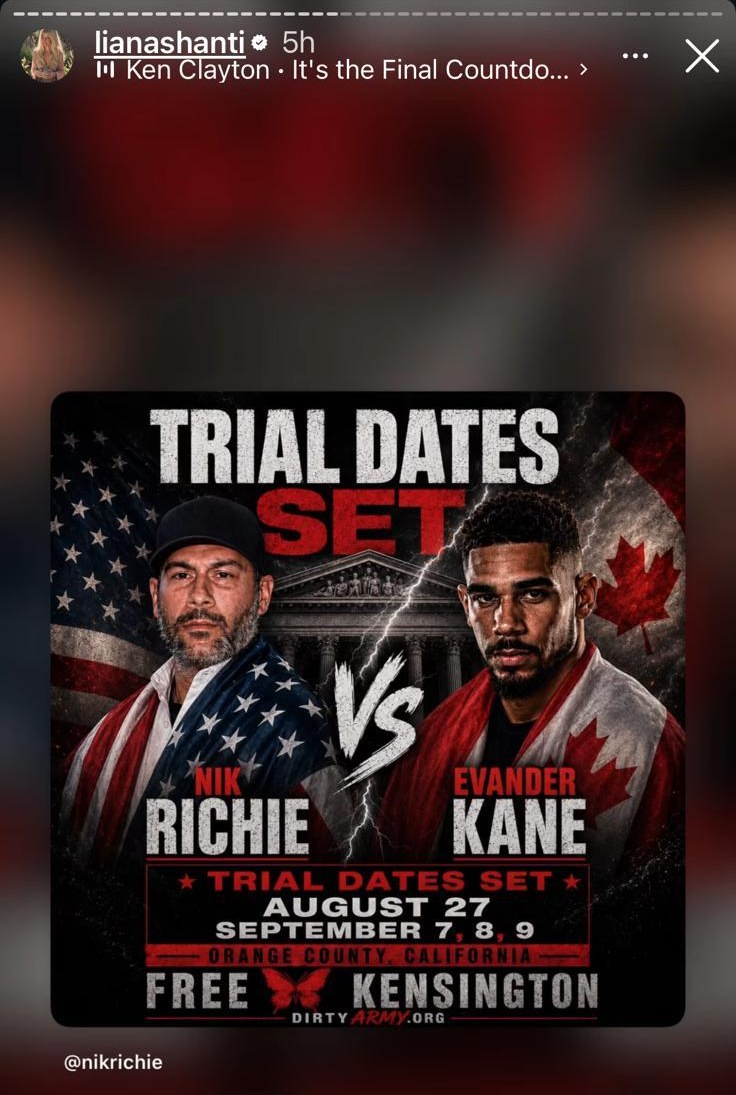
Source: Wilson (“Liana Shanti”) public posts; the linked “party of a century” story of July 10, 2026 (an Instagram Story stays live only 24 hours). See the Road to Trial page.
This page will be updated as the entered Judgment and the full verdict forms are posted to the public docket. Except for the note above on Wilson’s own posts, everything here is sourced to the court record; filings are one side’s contentions, and only the jury’s verdict and the court’s rulings are findings.